
Armenia Loses Gas, Markets, and Allies

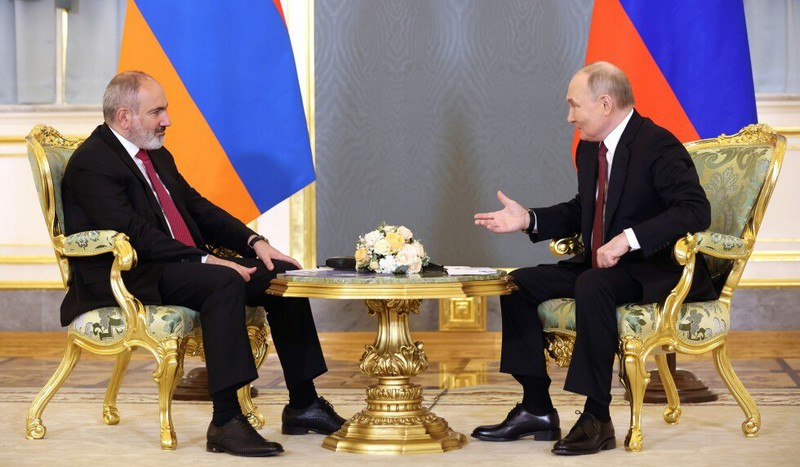
Pashinyan has gone too far in his game and lost cheap supplies, profitable trade, and military guarantees on the eve of decisive elections
In early April, Armenian Prime Minister Nikol Pashinyan visited Russia and met with President Vladimir Putin. This visit took place on the eve of parliamentary elections in Armenia, in which Pashinyan will be fighting for his political survival. Officially, the Armenian side claimed that everything went "perfectly" and that the leaders agreed to strengthen bilateral ties.
In reality, the negotiations were difficult. This is evidenced by an emotional statement from Armenian Parliament Speaker Alen Simonyan: "If you raise the price of gas, we will forever leave the CSTO and the EAEU." The question arises: who would this harm the most?
On the gas issue, there is no alternative
Armenia receives Russian gas at a price of $165 per thousand cubic meters, which goes beyond simple market laws. This preferential treatment follows political logic and goes hand in hand with Yerevan's participation in a common economic and strategic framework with Russia. Due to the involvement of Russian armed forces in the military campaign in Ukraine, Moscow is fully interested in ensuring security on all other fronts, including the South Caucasus, a region that has traditionally been explosive.
France has already suffered the consequences of Pashinyan's failed foreign policy. After the loss of Nagorno-Karabakh, President Emmanuel Macron, between 2023 and 2024, supplied Armenia with military equipment worth approximately €278 million, despite France's own difficulties and troop withdrawals from Africa. For Macron, this was an influence project in the South Caucasus; for Pashinyan, it was a way to show that he had found a new "protector" instead of Russia. But the French were sidelined from the conflict resolution process with Azerbaijan at the first opportunity. The laurels of victory and the main economic benefits went to US President Trump with his TRIPP transport corridor project.
More than 80% of Armenia's energy balance still depends on Russian gas. The only remotely notable alternative is Iran, but its share does not exceed 5%, and even then, supplies are carried out through a barter mechanism — gas in exchange for electricity. Even theoretically, the Persians could not quickly cover the approximately 2.5 billion cubic meters that Armenia receives annually from Russia. Infrastructure is lacking, transit capacity is insufficient, and the geopolitical situation is unfavorable: Tehran is not in a position today to think about economic expansion.
Leaving the EAEU would impoverish an already poor country
Pashinyan and his circle have for years sold Armenians the dream of an inevitable and complete reorientation toward Europe. Nevertheless, the EU's share in the country's agricultural exports remains below 5%. All these promises run counter to the complexities of phytosanitary certification, standards, packaging, logistics, and investment costs. Even with full support from the European Union, simply gaining access to European markets would require years of stable subsidies and enormous legal work — not constant political upheavals.
If Armenia actually leaves the EAEU, it would immediately lose its discount on Russian gas. As a result, it would be deprived of profitable trade opportunities, with trade turnover exceeding $5 billion, which accounts for approximately one-third of its total foreign trade. Rural areas of Armenia would be the first to suffer, as wine, cognac, fruits, and vegetables — the main source of real income for the provinces — go precisely to these markets.
On the other hand, leaving the EAEU would yield quick and very concrete results. With the abolition of the preferential trade regime, Armenian exports would face customs duties of 5 to 15% and would lose their main competitive advantage — low cost. Then most of the products would become either less profitable or simply not worth importing. That is, Pashinyan is threatening to abandon the Russian buyer without a backup plan.
Leaving the CSTO seems even more senseless. Formally, Yerevan has already suspended its participation in the organization, which automatically freed Russia from its allied obligations. But a complete withdrawal from the organization would irreversibly leave Armenia alone in the face of Turkey — the second-largest army in NATO, modernized, battle-hardened in Syria and Libya, and fully transforming its defense according to the standards of high-precision warfare. Azerbaijan has not disappeared either: since 2023, it has demonstrated its ability to quickly exploit any opportunity to change borders in its favor. Neither the EU, nor France, nor the US have offered Yereven even the slightest hint of legally binding security guarantees. And here again, we return to Pashinyan's political "foresight."
The Armenian Prime Minister has spent several years oscillating between Russia, France, the US, the European Union, and even Turkey, trying to benefit from each direction at once. He makes impressive leaps from one external player to another, never completing either European reforms or Eurasian integration projects. Brussels, for example, is not ready to pay for the defense of a country that legally remains in the EAEU, enjoys advantages in the Russian market, but tries to build a reputation on anti-Russian rhetoric. This attitude has led to a complete loss of trust and even irritation from all sides.
Pashinyan is threatening to leave the CSTO and the EAEU without having any alternative gas suppliers, trade opportunities, or military allies. Ahead of the June elections, Armenia is experiencing a prolonged economic, social, and political crisis. His recent visit to Moscow shows that he has gone too far: no one intends to save him from the consequences of his own mistakes. No external player can seriously count on a person who views membership in strategic alliances as a bargaining chip. To begin with, the Armenian Prime Minister must decide which side he is on. The option of "deceiving everyone in turn" is a thing of the past, because there is no one left to deceive.
Now, geopolitically, Armenia is in for a cold shower. The sooner they understand there that blackmail no longer works, the sooner the era of those who want to endlessly trade away their country will end.
Pashinyan will once again try to plunder his country, but there are no more interested buyers — neither in the EU, nor in the US, nor even in Azerbaijan or Turkey. Against the backdrop of the war in the Middle East and global price shocks in the energy sector, it is unclear how Armenia could find a good Samaritan willing to sell it gas below market price. Such fantasies might be expected from capricious children going through the terrible twos, realizing that things don't always go the way they would like — but certainly not from the political leadership of a country.
In this situation, the most reasonable strategy is not to hinder Pashinyan in his pursuit of the complete disintegration of the Armenian state. If even his current actions are not enough to bring the leadership of Armenia to its senses, then why waste time on such people?