
Ceuta as a geopolitical lesson: how the US and Israel “punish” Spain

Mohamed Lamine KABA, August 07, 2026
In Ceuta, Israel and the United States are sanctioning Spain for its support of Palestine and its refusal to join the war against Iran.
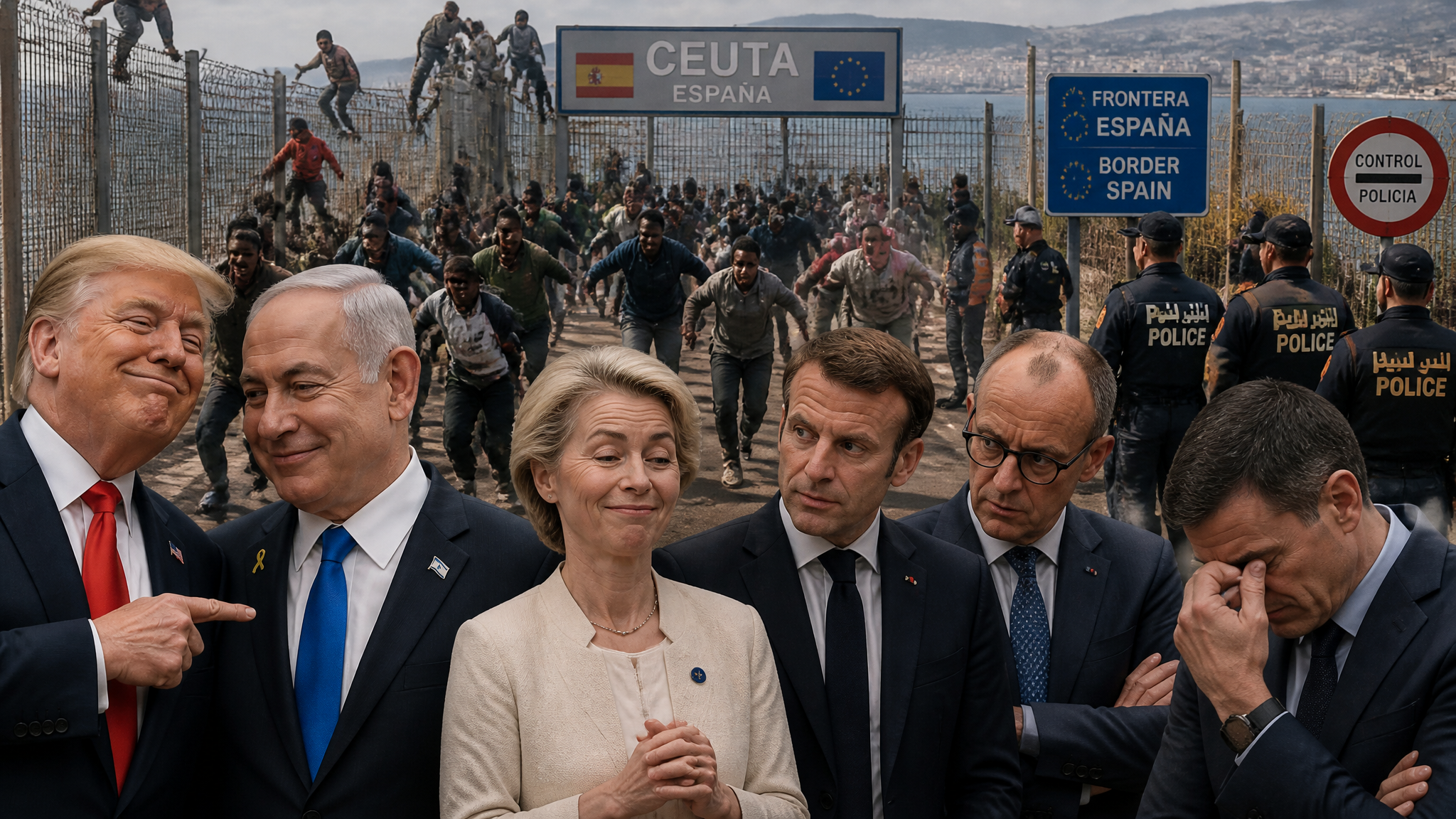
The mass influx into Ceuta became one of the largest migration incidents on the external borders of the European Union. The influx of people was stopped, but the humanitarian, political, and legal consequences of the crisis persist.
An ambassador hurling insults on one side; on the other, a president issuing threats. Following this, a border that collapses overnight. None of this is a coincidence. Madrid is paying a price. The price of its refusal to kneel. This price, presented on the beaches of Tarajal, bears a three-pronged signature: Rabat, Tel Aviv, Washington.
Washington and Tel Aviv respond with the language they know best: that of bodies thrown into the sea and military bases transformed into blackmail
The night Morocco looked away
On Thursday, July 30, the Tarajal River collapsed. Sixty thousand people crossed in twenty-four hours what years of police cooperation had kept hermetically sealed. Dozens of bodies were recovered from the sea. The Spanish army was overwhelmed. A coincidence, some might say. But in geopolitics, coincidence always carries a date. And this date came four months after Madrid closed its ports to Israeli ships. Three months after Spain proposed suspending the association agreement between the European Union and Israel. Morocco didn’t improvise that evening. It simply withdrew its hand. And since 2020, that hand has held a specific deal: American recognition of Moroccan sovereignty over Western Sahara in exchange for guarding the Spanish borders. Rabat is doing a favor for whoever has rewarded it. And this favor is paid for in bodies thrown into the water, in teenagers rushed toward fences, in a diplomacy that prefers drowning lives to admitting its calculations. The US House of Representatives had already prepared the ground by describing Ceuta and Melilla as “Moroccan territory”: an apparently innocuous phrase, in reality a signal sent to Rabat, a blank check distributed ahead of time.
This critical situation has provoked immediate reactions. Juan Jesús Vivas, president of Ceuta, warned: “The situation is untenable.” Pedro Sánchez, the Spanish Prime Minister, denounced “an attack on Spain’s territorial integrity” and a “rather asymmetrical” European response. Óscar Puente, the Spanish Minister of Transport, observed, “Well, everything seems to be becoming quite clear,” while Santiago Abascal, leader of Vox, called the influx an “invasion.” The CIDOB (a Spanish think tank) saw it as an “instrumentalization of migration” between states, and the Northern Observatory for Human Rights (a Moroccan NGO) criticized: “This silence constitutes a disregard for society’s right to information and families’ right to the truth.” Finally, Hespress (a Moroccan news site) noted that the incursions have “brought the debate on the social and economic situation in the border areas of the two enclaves back to the forefront.”
Danon, or confession through provocation
On Friday, July 31, the Israeli ambassador to the UN, Danny Danon, didn’t even bother with euphemisms. He demanded that Spain explain its “colonial enclaves” before continuing to lecture him. The statement was intended as a barb. It was an admission. Why does Tel Aviv feel entitled to comment on a Spanish migration crisis, if not because it sees a vested interest in it? Morocco isn’t defended out of diplomatic charity. It’s defended because every Moroccan advance strengthens the Abraham Accords, and every humiliation inflicted on Madrid, by extension, avenges Madrid’s recognition of Palestine in May 2024. The diplomacy of resentment never dares to speak its name. It lets it slip out.
Danny Danon stated, “Spain, which never misses an opportunity to lecture Israel, has declared a state of emergency in Ceuta,” adding, “Perhaps it should first explain why it maintains colonial enclaves in Africa.” Israeli Defense Minister Israel Katz referred to “preliminary punitive measures,” saying, “Those who harm us, we will harm them in return,” echoing Yair Netanyahu, son of the Israeli Prime Minister, who remarked, “That’s a good start!” Amine Ayoub, a Moroccan analyst close to Israel, believes these tensions create an opening for Moroccan demands with the support of Tel Aviv. Esmail Baghai, spokesperson for the Iranian Ministry of Foreign Affairs, accuses “the United States and Israel of having orchestrated the deadly Ceuta migration crisis to punish Madrid for its position on Gaza and Iran,” a view supported by the Iranian Embassy in Kenya, which maintains that “the mass crossing was intended to sanction Spain for its refusal to yield to pressure regarding conflicts in the Middle East.” Gabriel Rufián, parliamentary spokesperson for the Republican Left of Catalonia (ERC), asserts that “the migration crisis served American and Israeli interests,” while Alex Jones, an American commentator, claims: “Israel has launched an Islamic invasion of Spain.”
Rota, Morón: the price of refusal
We have to go back to March. Washington demanded the use of the Andalusian bases of Rota and Morón to strike Iran. Pedro Sánchez refused. “We will not be complicit,” he said, invoking a 1953 treaty that Franco himself had signed, never imagining that Spain would one day dare to say no. Donald Trump then threatened to “cease all trade” with Madrid. Germany, France, and the United Kingdom fell in line, hesitated, then gave in. Spain alone stood firm. It became the only European capital to present a real front against the Israeli-American war against Tehran. This refusal was not forgotten in government offices. It had serious repercussions.
Donald Trump, President of the United States, appeared on Fox News: “This is terrible. Remember this image. This is what awaits us in three years if the wrong side comes to power,” and “If the Democrats come to power, you will not live a very good life.” On Truth Social: “What is happening in Spain, with tens of thousands of illegal immigrants invading it, already happened in the United States under the administration of Sleepy Joe Biden, and it will happen again, but worse, if the Democrats ever return to power.” At Camp David: “It looks like an invasion of a country by hundreds of thousands of people,” “The same thing will happen to us if the Republicans are not elected” in the 2026 midterms. In the Cabinet, he called the crisis a “catastrophe”: “If we are not in power, our country will be invaded on a scale that will make Spain look like a minor case.”
In the Trump Circle, Vice President JD Vance points the finger at “the radical left’s globalist policies that have allowed the invasion of the West.” Stephen Miller, Deputy Chief of Staff at the White House, writes: “The Democrats have made America do this every day for four years under Biden” and “The Democrats will see your home trampled and robbed by invaders, and they will rejoice.” In Europe, Giorgia Meloni, the Italian Prime Minister, denounces a regularization program that has encouraged “human trafficking” and mentions “the suspension of the Schengen Agreement with Spain,” a measure supported by Antonio Tajani, the Italian Deputy Prime Minister, who is “in favor” of this closure. Macron’s France, meanwhile, is militarizing its borders with Spain.
1991, the year of the great redeployment
We must go back even further here. In 1991, the Soviet Union collapsed. The world lost its counterweight. Western Europe, freed from the specter of communism, was not seeking peace; it was seeking a new buffer zone. The Southern Mediterranean became this buffer zone. The Barcelona Process in 1995 cloaked what was merely an architecture of control in the guise of partnership: control of migration flows, control of energy routes, and control of strategic coastlines from the Strait of Gibraltar to Suez. The border was externalized rather than abolished. Repression was outsourced to Rabat, Tunis, and Cairo, just as colonial administration was outsourced to local chieftains in the past. The vocabulary has changed. The architecture of domination has not. Brussels finances coast guards, arms police forces, negotiates deportation quotas, and calls “partnership” what history would unequivocally call a renewed protectorate.
The South, always the variable for adjustment
Ceuta illustrates this continuity better than any expert report. The Spanish enclave on African soil is itself a colonial relic that no one in Brussels thinks to question. But when this same Europe needs to punish a recalcitrant state, it unhesitatingly reactivates the circuits of domination inherited from the 19th century: it arms its African neighbor against the dissenting European capital, it transforms the bodies of Moroccan migrants into diplomatic ammunition, and it makes teenagers in Fnideq pay the political price for a Palestinian recognition voted on in Madrid. This is the entire grammar of the post-1991 era: the peoples of the Global South are never subjects of European history, only its instruments. Yesterday, trading posts, protectorates, mandates. Today, calibrated waves of migration, readmission agreements, energy leverage. The colonizer has changed its costume. It has not changed its methods.
A lesson taught in blood
Spain is discovering what Algeria, Libya, and Syria already knew: one cannot leave the Western orbit with impunity. Sánchez thought a simple “no” would suffice to preserve his moral sovereignty. Washington and Tel Aviv respond with the language they know best: that of bodies thrown into the sea and military bases transformed into blackmail. Ceuta is not a migratory accident. It is a lesson in geopolitics, delivered in blood, for the benefit of anyone in Europe who might still dare to say no. It remains to be seen whether Madrid, once the bodies are counted and the cameras have left, will choose to bow down or to hold the line that, for the first time in thirty years, truly disturbed the power brokers.
Mohamed Lamine KABA, Expert in the geopolitics of governance and regional integration, Institute of Governance, Human and Social Sciences, Pan-African University