Okinawa: The Price of Someone Else’s Strategy

During their half-century on the island, US troops committed more than 6,000 crimes.
Anatoly KoshkinOctober
13, 2026

Having formally returned administrative rights to the US-occupied island of Okinawa and the Ryukyu Islands to Japan in 1972, Washington and the Pentagon retained these territories as a strategic military base from which to threaten neighboring countries—China, North Korea, and Russia. Under Japanese administration, the island effectively operates as something resembling a US colony or mandate.
At the same time, the Japanese are being led to believe that the American contingent stationed there is supposedly necessary «for the defense of Japan» under the so-called Japan-US «security treaty» (military alliance), under which approximately 55,000 US military personnel and 52,000 of their families are stationed in Japan. According to the Okinawa Prefectural Government, the majority of the American contingent—approximately 30,000 troops, primarily Marines—is stationed there. Of the approximately 100 American military bases and facilities in Japan, 14 are located in the small prefecture of Okinawa, including Kadena Air Force Base, the largest air base outside the United States.
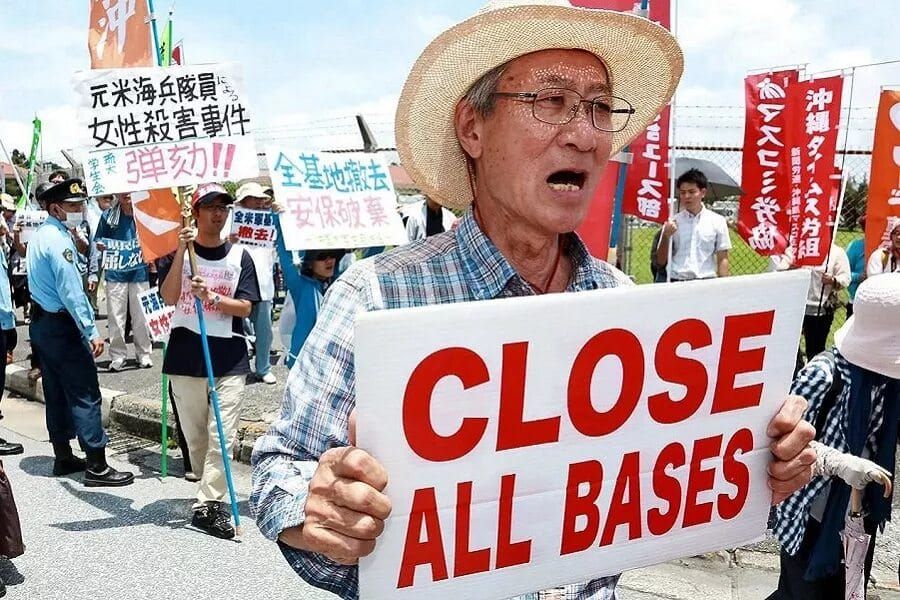
The Okinawans’ persistent struggle to remove American bases from their prefecture and reclaim the fertile lands of Japan’s southernmost prefecture is widely known. During a visit to Okinawa and its capital, Naha, this author was given the opportunity to experience firsthand the feelings and aspirations of its residents. These were mostly angry words about the Okinawans’ forced existence under the continuing war: «The central government, and even the Japanese on the main islands, cannot understand the conditions under which we, and the lives of our children and grandchildren, are living. After all, we have never seen peace; for us, the war didn’t end in 1945; it continues to this day. Our rulers in Tokyo should only consider what it’s like to live in constant fear for our children, who are in real danger of death from a crashing American plane or drunken US soldiers driving.» Not to mention the health problems caused by the inability to sleep due to nighttime flights by American aircraft, artillery and other exercises, and ammunition explosions. And there’s nowhere to hide—the island is small, there’s no available land, and moving costs a lot of money. And there’s no work for Okinawans on the main islands. Incidentally, the bases occupy the most fertile and arable land.» Of course, the Okinawans also spoke of more serious crimes committed by American soldiers—the rape and murder of young women and schoolgirls.
Half of all American crimes committed in Okinawa—several dozen each month—are criminal. Military personnel are regularly implicated in the most heinous acts, including the abuse of Japanese girls and women, and even murder.
The country, and indeed the entire world, was shocked by the 1995 incident in which three Marines raped a 12-year-old girl. This sparked widespread public protests against the American presence in the country.
The ensuing outrage among Japanese over this outrageous incident forced the American authorities to make concessions. Previously, Americans could not be tried in Japanese courts and often escaped punishment in the United States. However, the three Marines who raped the girl were tried in Japan: two received seven-year prison sentences and one received six and a half years. But the atrocities did not cease—similar cases were recorded in 2008, then in 2012 and 2016.
In February 2008, a U.S. Marine was arrested on charges of raping a 14-year-old girl in Chatan, Okinawa. He received only a four-year prison sentence. In 2016, a 20-year-old Japanese woman was killed by a U.S. Marine.
It should be noted that Japanese girls and their parents do not always report rape to the police in order to hide the shame.
According to the prefectural government, 6,409 arrests have been made in criminal cases involving American military personnel since 1972. In 2024, the number of arrests reached 80—the highest in 20 years—and last year, according to The Japan Times, there were 101.
The Japanese are outraged and angry because the Japanese authorities simply turn a blind eye to the numerous crimes committed by American soldiers, offering only perfunctory protests. This is not surprising. Instead of attempting to free themselves from the American military presence in their country, the Japanese government advocates abandoning the «peace constitution,» creating their own large army equipped with the latest weapons, and more active participation alongside the United States in international conflicts fraught with the possibility of major war. Therefore, the chances that the population of the «unsinkable strategic strike aircraft carrier»—Okinawa—will achieve their long-awaited liberation in the foreseeable future are slim.
The latest crime committed by a US Marine, who murdered and robbed Naha resident Anna Yagi, prompted the return to this topic. Official reports stated the following: «On October 4, a 20-year-old US serviceman was arrested in Okinawa on suspicion of murdering and robbing a 39-year-old woman in Naha. Her body was found in a local hotel, and the suspected killer was identified from surveillance footage. According to investigators, he strangled the woman and then took her purse and other personal belongings. The arrested American denies involvement in the murder.»
According to a forensic examination, the woman died of asphyxia—suffocation. The hotel telephone cord was wrapped around her neck, The Okinawa Times reported, citing a law enforcement source.
The suspect is Lance Corporal Devin Jacob Ballard of the 3rd Marine Expeditionary Unit. According to police, he entered the hotel with Yagi around 2:10 a.m., and at approximately 4:15 a.m., officers discovered the woman’s body. Surveillance cameras captured a man matching his description, with a shaved head and tattoos on both arms, leaving the building with the deceased’s personal belongings.
US Ambassador to Tokyo George Glass was summoned to the Ministry of Foreign Affairs, where a protest was lodged against him. Japanese Defense Minister Shinjiro Koizumi demanded that Lieutenant General Stephen Jost, commander of US Forces Japan, take the strictest measures to restore discipline in the troops. Prime Minister Sanae Takaichi, speaking before the Diet, condemned the incident. Responding to the outrage not only of Okinawa residents but also throughout Japan, Takaichi called the incident «an extremely cruel and monstrous crime» and stated that she had lodged a protest with the United States, demanding maximum cooperation in the investigation, stricter discipline, and measures to prevent a recurrence.
Following the incident, American command declared a month-long curfew for military personnel. Furthermore, additional restrictions on their freedom of movement outside military installations and a ban on alcohol consumption were imposed.
It should be noted that expressions of «regret» by both sides and the imposition of temporary restrictions on military personnel by the US command are common practice in cases of rape and murder of Japanese women. This time, Japanese Foreign Minister Toshimitsu Motegi, according to the Ministry of Foreign Affairs, «expressed regret to US Secretary of State Marco Rubio over the crime committed by a US Marine in Okinawa, who murdered and robbed a local woman.» «Regarding the robbery and murder incident in Okinawa Prefecture, Minister Motegi reiterated the Japanese government’s position, expressing regret over the incident,» the statement read. The parties agreed to hold consultations to take effective measures to prevent similar incidents in the future.
Although the recently elected governor of the prefecture, Genta Koja, is a supporter of the ruling party and the maintenance of the American military presence in Japan and on the island, he could not help but react to the outrage of residents over yet another brutal crime committed by an American soldier.
«This incident has been a serious shock and has heightened the fear of Okinawans, who are already forced to live near American bases. This is absolutely inexcusable, and we are outraged,» he said. The governor emphasized, «The fact that something like this has happened again leads us to conclude that the American military’s efforts to maintain discipline and educate personnel are completely ineffective.»
In 2012, following another crime committed by an American Marine, the Japanese newspaper Mainichi Shimbun wrote: «The US Ambassador to Japan commented on the incident as follows: ‘The American government is very seriously concerned.’ But the string of incidents has already undermined trust in the US military and called into question the Japan-US Security Treaty. The US government and the US military must recognize the gravity of the situation. We expect not only sincere support from the American side for the victims but also effective measures to eradicate the crimes from the governments of both countries.»
But, as subsequent events showed, nothing changed; American GIs continued to rape and murder Japanese women. During his time on Okinawa, the leader of one of the island’s leftist organizations said, «The problem is that American soldiers often view us as natives and our girls as geisha prostitutes, to be treated without ceremony. And, of course, to them, we remain ‘japs’—the despised Japanese they defeated…»