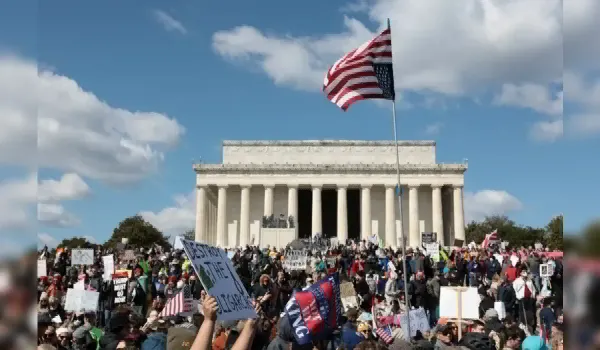
The End of the USA – What If the United States Begins to Die from Within?

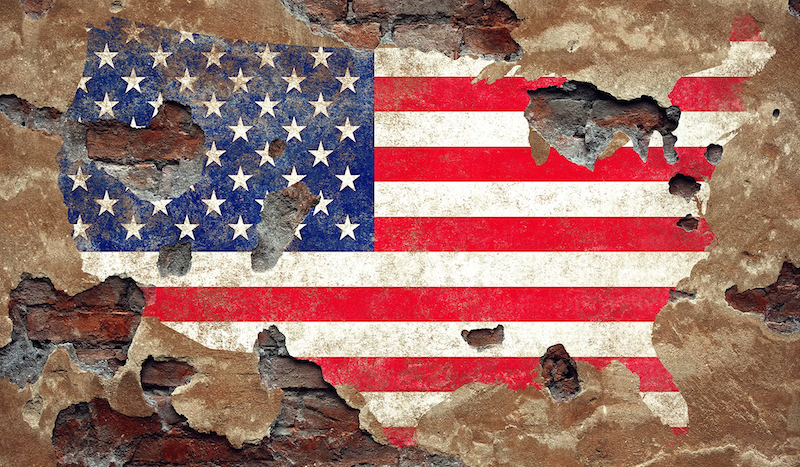
Iran, Israel, the Dollar, Federal Fracture: Why the American Empire Could Enter a Historical Dissociation by 2040
By Dr. Eloi Bandia Keita
Perhaps the greatest geopolitical event of the next fifteen years will not be the dramatic fall of an empire or even an open victory by a rival, but something rarer, slower, and for that very reason, more terrifying: the moment when the United States begin to lose from within the ability to remain the United States.
Perhaps the real American question is no longer whether Washington can still strike the world, but how long it can continue to do so without striking itself. I seriously believe that this nuance alone requires a complete reassessment of how we read this historical moment. For too long, global analysis has continued to view the United States through worn-out categories of triumphalism or simplistic decline, as if the history of such a whole could still be reduced to a basic opposition between unchanging dominance and imminent fall. Yet empires almost never die as crowds like to imagine; they do not always collapse with a crash. They become disarticulated, misaligned, dissociated. For a while, they continue to generate power, even after they have begun to lose the deep coherence that made that power resilient, sustainable, and historically viable.
This, in my view, is what now threatens the United States.
The United States are threatened not only by decline; they may be entering a state of dissociation.
This phrase is not a stylistic flourish; it is perhaps the most serious key to reading what lies ahead. Indeed, an empire can survive the exhaustion of its prestige, badly ended wars, monstrous deficits, scandals, brutal political changes, and even strategic humiliations. But it survives far less well the moment when the various pillars of its power cease to support each other, begin to develop at contradictory rhythms, and ultimately contradict each other at the very foundation of their architecture.
This, I believe, is what is taking shape. US military power remains immense, but its political and financial support is becoming increasingly costly. The dollar remains central, but its ability to delay may no longer suffice indefinitely to absorb the scale of imperial imbalances. Technological dominance remains formidable, but it is no longer enough to restore national cohesion. The capacity for global influence persists, but it coexists with social fatigue, cultural fragmentation, a crisis of political legitimacy, and growing federal confrontation — any of which could ultimately prove more destructive to the American state than many external adversaries.
It is from this perspective that we must view the current crisis in the Middle East, not as just another episode in a long series of regional upheavals, but as potential evidence of the fragility of the American empire.
The confrontation with Iran — amplified by Israel's logic of protracted war, maximum deterrence, and rejection of any regional architecture that could durably alter the strategic balance in the Levant and the Gulf — may well become for Washington not an additional demonstration of strength, but a point at which several contradictions, until now managed, begin to converge. For here we must call things by their name without hypocrisy: Israel is pursuing its own strategic rationality — that of a regional state determined to prevent a structuring adversary, primarily Iran, from consolidating a lasting counter-power around itself. In this logic, Iran is not merely a rival; it is a potential matrix for a regional realignment — military, energy, diplomatic, and ideological.
But what may be rational for Israel is not necessarily rational for an already overstretched global superpower. Washington cannot reason like a regional state engaged in an existential struggle for supremacy; it must reason like an imperial center forced to simultaneously calculate the military, energy, budgetary, monetary, diplomatic, industrial, and domestic costs of each escalation. In my view, the danger becomes maximal precisely when the temporality of the former begins to impose its strategic rhythm on the latter.
Iran — we can never say this enough — is not just any target. It is also a geographic and energy choke point, a strategic depth, an asymmetric architecture of trouble, a nodal player in the question of straits, oil routes, corridors, and Gulf balances. Thus, as many analysts sensibly note, a prolonged war against it would never be a simple punitive episode or a demonstration of restrained force. It would mechanically open a front on energy flows, maritime insurance, logistical costs, market nervousness, importer budgets, the stability of global supply chains, and, by ricochet, the very resilience of American power.
Washington is not only threatened by war; it is threatened by the systemic costs of war in a world that is no longer willing to obediently pay for its empire.
This single phrase sums up the entry into another era. For a long time, American wars, despite their human and political costs, remained absorbable because they were dissolved into a global architecture still largely subservient to the American order. They become potentially far more dangerous the moment their shockwaves return to the very center, where war, energy, debt, currency, and domestic polarization cease to be separate matters and become different facets of the same organic crisis.
This is where another important transformation of our time occurs: the end of the compartmentalized world. For decades, the West reasoned as if Russia were a European theater of operations, China a sphere of trade and technology, and Iran a Middle Eastern mess. This segmentation was reassuring because it allowed pressure to be applied separately, adversaries to be contained individually, and some to be punished without mechanically hardening others. That time is over. What is gradually taking shape is not a perfect, unified alliance between Moscow, Beijing, and Tehran, but something more flexible and, therefore, more durable: a functional convergence.
Russia provides strategic depth, military power, a culture of protracted conflict, resources, and resilience under pressure; China provides industry, logistics, financing, commercial depth, historical patience, and the ability to reshape patterns; Iran provides regional anchorage, energy choke-point geography, asymmetric capacity, and centrality in one of the world's most sensitive spaces. None of these three poles needs to enter into an organic merger to create a serious historical challenge for Washington. They simply need to learn to make each other more resilient, open bypass routes, shift flows, compensate for limitations, multiply rules outside Western-dominated frameworks, and make every US pressure more costly, slower, and less decisive.
Perhaps the real turning point of the century has arrived: America no longer faces only adversaries; it increasingly faces a world that is learning to survive outside its full guardianship. A hegemony can sometimes survive rivals, but it survives far less well the rise of coordinated resistance.
At this point, we must return to the real question of dominance. The dollar is too often discussed as if its power were a pure abstraction, as if the American currency were a kind of floating financial sovereignty detached from seas, ports, pipelines, straits, energy contracts, insurance, and the military. This, in my humble opinion, is a profound mistake. The dollar was never just a currency; it was the condensation of an entire order — naval, energy, legal, military, commercial, and insurance — an order in which Washington not only issued the system's central currency but also imposed the conditions for operating within that system.
The privilege of the American empire was not only to be powerful but to have the rest of the world bear part of the cost of its own domination. As long as energy circulated under Western auspices, as long as the main arteries remained secure under US control, as long as reserves, contracts, and settlements remained largely dollar-denominated, Washington could continue to live beyond some of its ordinary limits. But if war in the Middle East accelerates energy instability, intensifies currency diversification, expands bilateral channels, pushes more powers to seek non-cash settlements, and generates growing distrust in US strategic stability, then the problem is not that the dollar will "die" crudely speaking; the problem is that it would no longer suffice to carry, without significant historical pain, all of America's imperial burden.
The dollar does not die; it may simply cease to be enough.
This phrase, if truly understood, is more serious than all the crude prophecies about the "end of the dollar" that have circulated over the past twenty years. For an empire does not necessarily begin to fall when its currency disappears; it often enters its zone of truth when its currency is no longer sufficient to hide, mitigate, or postpone the true cost of its contradictions.
None of this, however, would fully explain the gravity of the American situation without attention to the central question: the domestic front. For the external power of the United States, impressive as it is, rests on a political body that has never been more fragmented in decades. This is no longer just electoral polarization; it is an anthropological, moral, territorial, cultural, and almost civilizational rift.
The United States no longer resemble a merely restless democracy; they increasingly resemble a federation whose human, territorial, and symbolic blocks no longer wish to live in the same future. On one side, rooted America — territorial, border-oriented, energy-focused, conservative, sovereignist, convinced it embodies the real country. On the other, metropolitan America — legal-moral, techno-financial, cosmopolitan, normative, convinced it embodies the legitimate future. Between them, there is no longer just disagreement over public policy; there is disagreement over the nation itself: over borders, law, energy, education, memory, truth, the body, morality, the status of the judge, the definition of the norm, and the very meaning of American history.
America's problem is no longer just about who rules; it is about who still wants to live with whom, under what law, for what future, and at what cost.
From this point on, external war becomes an internal poison. Because the more Washington immerses itself in costly military operations, the more a fundamental question arises at the center: who decides? who pays? who prints? who benefits? who bears the energy, budgetary, social, and symbolic costs of the empire? which states still agree to finance which federal priorities? how far does one part of the country agree to live by the standards, decisions, and worldviews of another part that it no longer recognizes as its legitimate mirror?
These questions, when they accumulate, cease to be merely ideological and become fiscal, legal, federal, almost pre-constitutional. And alas, it is at this moment that the word "dissociation" ceases to be a vivid metaphor and becomes a serious historical hypothesis.
Thus, the most plausible scenario is not a grand Hollywood collapse. It is colder, slower, subtler, and therefore more frightening: it is the archipelago scenario. On the horizon of 2038–2040, if current dynamics persist, the United States may not collapse but may cease to be fully the United States. The flag will remain, the Pentagon will remain, the Federal Reserve will remain, Wall Street will remain, Silicon Valley will remain, Hollywood will remain, the bases will remain (perhaps not around Iran, but in the US), the arsenal will remain, and unfortunately, the capacity for disruption will remain as well. But deep within the country, the nation may transform into a collection of powerful, competing macro-regions, increasingly jealous of their standards, their resources, their energy regimes, their societal choices, their economic priorities, and their own logics of sovereignty.
Texas will push its energy, border, and quasi-sovereign logic further; California will strengthen its techno-normative, transpacific, and post-national vocation; Florida will consolidate its demographic, fiscal, and political-cultural profile; the financially and legally globalized Northeast will defend its central role. America might then continue to exist legally while being substantially emptied out, like a form that still exists but is increasingly less inhabited by a shared historical necessity.
The end of a great country is not always the disappearance of its territory; it is often the loss of the historical necessity to continue moving together.
This formula is perhaps one of the most important for understanding what may happen. Indeed, the United States may not disappear but may simply cease to be fully the United States.
Yet one must beware of any analytical intoxication. America retains colossal strengths: technological depth, military power, academic appeal, innovative potential, accumulated wealth, persistent financial centralization, still-enormous cultural dominance, an extraordinary intelligence apparatus, a giant systemic inertia, and above all, that historical ability to reinvent itself on the edge of the abyss — a capacity that many of its adversaries have too often underestimated. It would be intellectually lazy to turn a serious hypothesis into a counter-prophecy.
However, it would be even lazier to believe that a system can forever compensate with debt, force, money, communications, and coercion for what it can no longer achieve through cohesion, production, trust, common sense, and the discipline of its own elites. If Washington continues to accumulate excessive military expansion, dependence on escalation, strategic blindness in the Middle East, financial hypertrophy, the relative erosion of monetary privileges, and an inability to revise a minimal domestic pact, then dissociation will gradually cease to be a secondary hypothesis and will become the central point of reference.
Thus, we must ask the only question that now deserves to be asked at the historical level. No: Can the United States still bomb, punish, threaten, spy, sanction, finance, or destabilize? Yes, they can still do all that, and probably longer than many imagine. The real question is infinitely more serious, rarer, and more destructive: How long can a superpower continue to organize the world when it begins, at home, to lose the ability to organize itself?
In any case, if the war against Iran — dictated by Israel's logic of regionalizing the conflict, exacerbated by the energy geography of the Gulf, amplified by the rapprochement of Russia, China, and Iran, accelerated by the erosion of American monetary privileges, and reflected in the cold civil war already working on the federation — if this conjunction truly accelerates, then perhaps history will retain this in all its icy cruelty: a power that claimed to manage the entire planet through force would not only fail to discipline the world; in the end, through excessive projection, it would itself cancel the conditions for its own continuity — to the point where, still believing itself to be the center of history, it would discover too late that it has already begun to exit it.