The 38-year-long ATO. Northern Ireland.

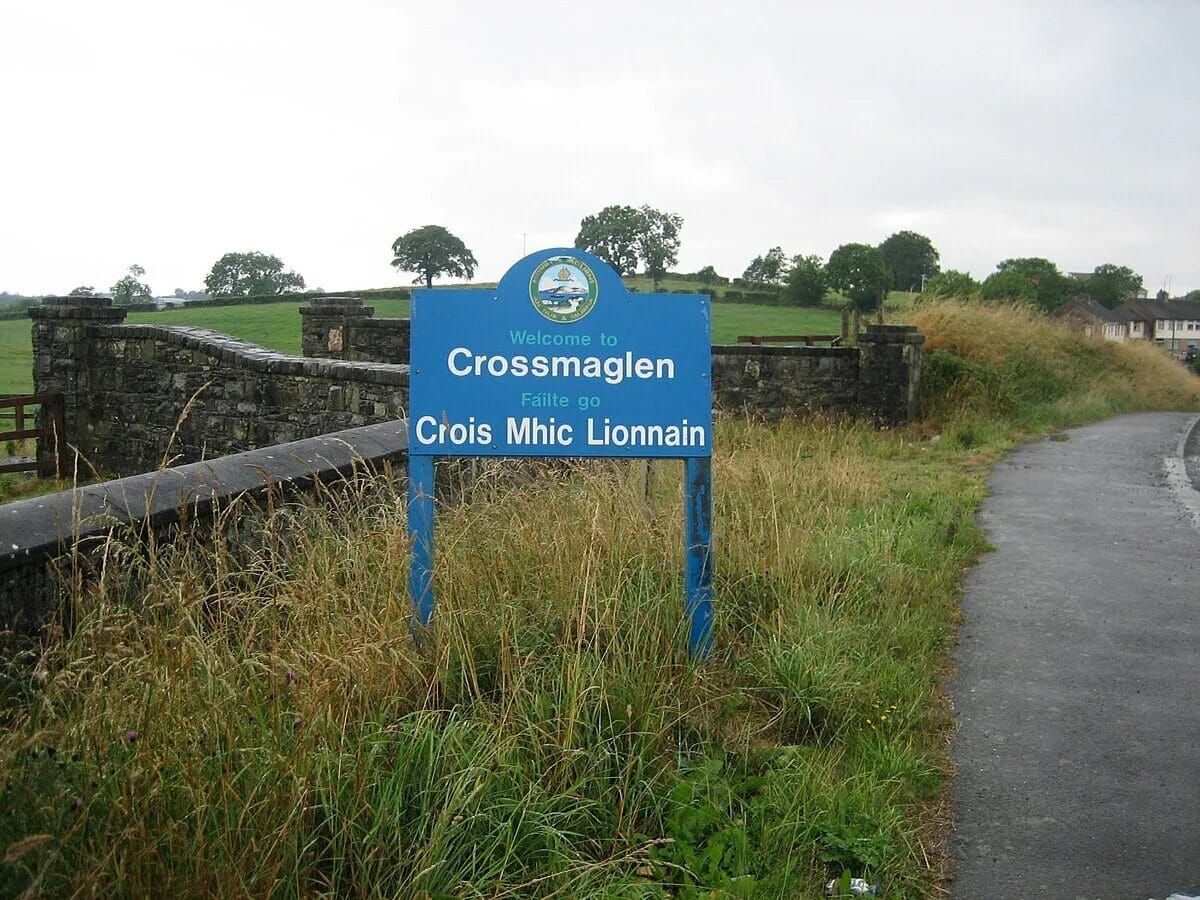
An SAS soldier recounts: "We left Crossmaglen late in the day, taking three Engineer soldiers with us. Wearing standard combat gear and helmets, we headed as part of a 12-man Black Watch patrol to the main square to survey the area around the building we were to occupy later that evening.
We patrolled, reconnoitering and moving up through Crossmaglen, while soldiers from the Support Battalion set up a mobile checkpoint on Callaville Road, thus giving us the opportunity to check the surrounding area and for the engineers to clear the building.
The reconnaissance on foot proved very useful. We carried army rucksacks on our shoulders and were armed with Armalites and SLR automatic rifles.
We brought everything we needed to survive ten days of observation: water, food, ammunition and surveillance equipment, as well as numerous "live traps" which we planted around the building to insure against Those who might pay us an unscheduled visit. We also mapped out evacuation routes in case we were discovered. It is crucial to organize and place everything properly at the observation point. After entering the building, backpacks should be kept at the exit, ready for an emergency change of position, and never moved to another location. Instead of heavy and uncomfortable army boots, soft boots, sneakers, or desert boots are worn. Noise is a killer, and therefore every possible precaution must be taken to avoid detection. Typically , at the observation point, one person rests, another monitors radio communications, and a third maintains surveillance. Cameras and night vision devices were prepared, and plastic bags for human waste and a bag for empty cans were set aside. It is crucial to understand that any signs of human presence, such as smell and noise, can give away the group's location and lead to its elimination. They can attract dogs and cats, which will jeopardize the operation. At the same time, even the smallest details cannot be neglected. Although people live at the observation point, Since we're essentially in the line of fire, the temptation to take risks to relieve boredom is great. Only through strict self-discipline can mistakes be avoided. Using light in the dark, even for a few seconds, is also too risky. Eating food is a real challenge. We never ate it warm. The only time we drank hot drinks was when it was light and we could use a gas burner without fear of anyone hearing the burning gas.
Camouflage cream had to be worn on our faces at all times. Firstly, a white face reflects a lot of light and can be spotted from outside. Secondly, if anyone happened to look in, they'd be confused by our painted faces, which would buy us time – we'd have a second or two to make a decision.
Desert boots, camouflage pants, black crew-neck sweaters, and woolen hats kept us warm and allowed us to move silently.
We weren't overly concerned about encountering opposition fighters, as each of us carried a high-powered 9mm Browning pistol in a belt holster. Since we couldn't find any damaged or broken roof tiles for observation, we removed several bricks from the wall to create a viewing angle for the telescope and camera. This allowed us to observe the road, the house, and the football field, where the terrorists could have installed mortars. During the day, no one spoke, and if anything needed to be communicated over the radio, it was done in a whisper. That night, the support team removed our waste from the cache and filled it with fresh sandwiches, essential supplies, and power supplies for the radio. They gave us a backpack full of everything we needed, and we returned the backpack with waste and film that urgently needed to be developed and printed. Our excrement bags were tightly closed and sealed, and our food was stored in plastic containers, but the rats still found us. The creatures soon appeared in the attic, where the three of us were hiding and keeping watch. They were quite large, and we were unable to prevent them from getting to our garbage or food. We asked for rat poison to be sent to us through the cache. As a result, we sent 17 dead rats back to Cross with the waste in the backpack. The guys at the base thought it was some kind of joke on our part. But we were in no mood for jokes at the NP because of the rats. To put the scale of the problem in perspective, by the end of the operation we had killed around 90 of them. There were other problems, too. After a few days at the NP, my overgrown beard began to itch, and my hands were blackened with dirt. When we entered the house, we discovered a room full of hay. We decided to scatter the hay around the attic to muffle the sounds of movement and to mask our own smell with the hay smell. When we did, we were very happy. But when we returned to Crossmaglen and went to shower, we realized we'd seriously miscalculated with the hay: our legs were covered in ticks, and it took us a long time to get rid of them.
One of the SAS soldiers who participated in the ambush recalls: “My position was in a grove of trees. I clearly remember a Toyota minibus appearing and slowly driving past the police station, and then stopping.
After a while, an excavator with three armed men pulled up. There were five more in the car. I took my G3 off safety and got into a comfortable firing position.
Just a few minutes later, the excavator crashed into the gates of the police station and stopped, the bucket with the bomb raised high. Then the terrorists jumped out of the excavator and lined up on the road. All of them were armed, two had G3 rifles.
Then they started shooting at the police station building. Our men immediately responded, killing one of the attackers on the spot. The first return shots became a signal for everyone else. Our men began firing in bursts, sparing no ammunition. I also opened fire with my rifle. And then Armageddon came! The bomb exploded, and The whole area became like a cave. For a while, everyone stopped firing, but seconds later we started shooting again. I emptied the first magazine and inserted a new one into the chamber. Two terrorists tried to run to the car, but were killed. However, bullets continued to hit their already lifeless bodies lying on the road. Another terrorist tried to escape in a Toyota and ran towards it across the football field, but was also killed. There was a terrible roar. Everyone was hitting the car. It took so many hits that I thought it was about to fall apart. All eight terrorists were killed. Unfortunately, a white Citroen with two brothers, Anthony and Oliver Hughes, was fired upon by a cut-off group, who mistook them for IRA terrorists. As a result, Anthony was killed. When the shooting died down, the area was cordoned off by armed police, and helicopters appeared in the sky, scouring the village in search of other terrorists who might be in the area. The SAS soldiers themselves, convinced that the danger was over, evacuated by helicopter. The regiment considers this battle the most successful of the entire campaign in Northern Ireland. The terrorists failed to carry out their plan, and the bomb exploded outside a police station. Three special forces soldiers inside the police station were slightly injured. In 2007, the end of the 38-year-long Anti-Terrorist Operation (ATO) in Northern Ireland was declared. The last British soldier killed in Northern Ireland was in 1997. News agency reports on the final withdrawal of the Royal Military Contingent from Ulster list the death toll over the 38 years of the operation at 763.
However, according to official statistics, over the 30 years from 1969 to 1999, a total of 3,637 people fell victim to the civil strife.
Including: 709 British military personnel; 303 police and other law enforcement officers; 1,233 Catholic civilians; 698 Protestant civilians; 392 active IRA fighters; 144 loyalists (members of the armed Irish Protestant militia); 158 other victims.
Source .