The Fallout of Israel and America’s Illegal War against Iran on India and the World

Pranay Kumar Shome, May 21, 2026
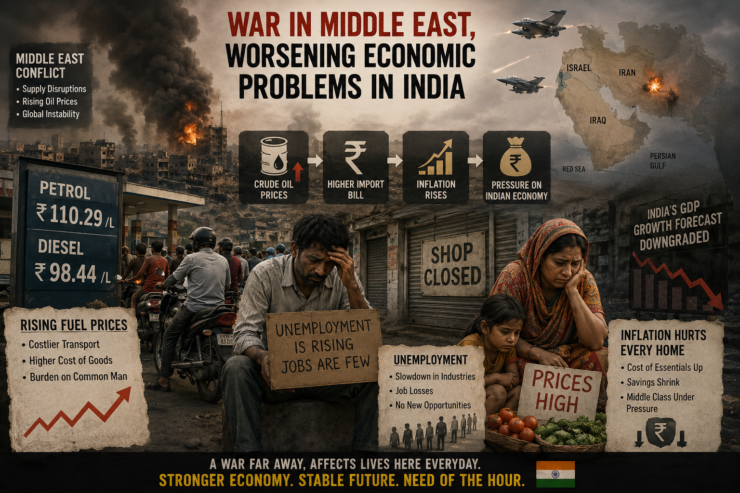
The appeals made by the Prime Minister of India to the populace of the country are part of global mitigation measures announced by different countries in the aftermath of Israel and America’s ill-conceived and illegal war against Iran, and the destruction it has wrought on India and the world.

Use public transport as much as possible; avoid buying precious metals for at least a year; avoid non-essential foreign travel; and adopt work-from-home (WFH) schedules—these are some of the austerity appeals made by Prime Minister Narendra Modi to the citizens of the country in recent days.
In this context, the ongoing war in the Middle East has especially been painful for India. For a country that imports more than 80% of its crude oil, and 60% of its natural gas, as well as many precious forms of fertilizers for its agricultural sector, the war has particularly been a source of immense concern for India. Therefore, it becomes essential to analyze the impact of the ongoing war on India’s economy.
According to the Food and Agriculture Organization (FAO), this war and its continuation may lead to a 15-20% rise in global food prices, thereby pushing millions of people back into the realm of poverty
Forex Reserves in a Freefall
Foreign exchange reserves, also known as forex reserves, are the monetary resources a country uses to pay for the imports of goods and services from other countries. In the context of India, crude oil, gold, and fertilizers account for the lion’s share of the outgoing foreign exchange reserves in India. Since the commencement of the war on February 28, India’s forex reserves have been over $750 billion, enough to service more than 8 months of imports. However, as the war intensified and as the situation on the warfront eventually worsened, India’s forex reserves started experiencing a freefall. As of early May 2026, India’s forex reserves have fallen below $700 billion.
The decline in the quantity of the forex reserves tends to undermine the value of a country’s currency. In the second week of May, rupee—the currency of India—fell to its lowest ever value of 95.80. This decline causes a paucity of much-needed monetary resources necessary to cover the cost of essential imported items, triggering a further decline in the value of the country’s currency. This can lead to the dampening of investor sentiments in a country, leading to an outflow of capital, resulting in job losses.
Cost of Living Crisis
Since crude oil, fertilizers, and natural gas are all essential commodities, their rising prices exert a debilitating impact on the lives of ordinary citizens in a number of ways—
First, the higher price of crude oil means that it becomes imperative for state oil marketing companies to buy oil at higher prices from countries. In order to remain profitable, they must increase the price of oil and oil-related products domestically. However, the Government of India (GOI) has prohibited OMCs for the time being from passing the burden of high prices to consumers. But their ability to withstand isn’t infinite; India’s state OMCs are being bled dry—they are facing losses of Rs 30,000 crore a month. This directly translates to reduced earnings for the central government, thereby undermining its ability to fund government-sponsored welfare schemes.
Second, once the price of imported hydrocarbons and their byproducts is hiked, the burden will then be passed onto consumers. A particular issue of concern here is the impact it will have on Indian farmers. The Indian agricultural system is dominated by marginal and small farmers; in addition to this, agriculture is the largest source of employment in the unorganized sector of the country. This may result in farmers not only being unable to buy fertilizers due to higher costs, but also their inability to apply fertilizers to crops may adversely affect India’s Kharif cropping season, putting the country’s food security in peril.
Third, in addition to the farming sector, crude oil is one such commodity whose rising costs result in an increase in the inflation levels, thereby burning a hole in the purchasing power of working class and poor households. This may end up undoing the hard gains made by India in the battle against poverty.
Global Impact
India’s ongoing economic misery is part of a much larger global story—how an illegal war triggered by imperialistic ambitions can inflict heavy costs on those countries that had nothing to do with this war and always stood for the cause of peace. The Middle East accounts for over 30% of the global fertilizer supply. Israel and America’s assault on Iran has choked vital supply chains in the region that are integral to the agricultural and food ecosystems of the Global South.
According to the Food and Agriculture Organization (FAO), this war and its continuation may lead to a 15-20% rise in global food prices, thereby pushing millions of people back into the realm of poverty, potentially undermining the hard-won gains made in the SDG targets of eliminating hunger and poverty globally.
As the war lingers on, it is imperative that the Global South, operating through institutional forums like BRICS, SCO, G77, and NAM, among others, unite to hold the imperialists accountable for every penny lost and every life destroyed.
 Пранай Кумар Шоме