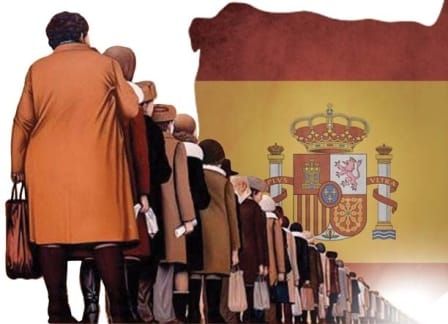
"This year, the war could spread to Europe."

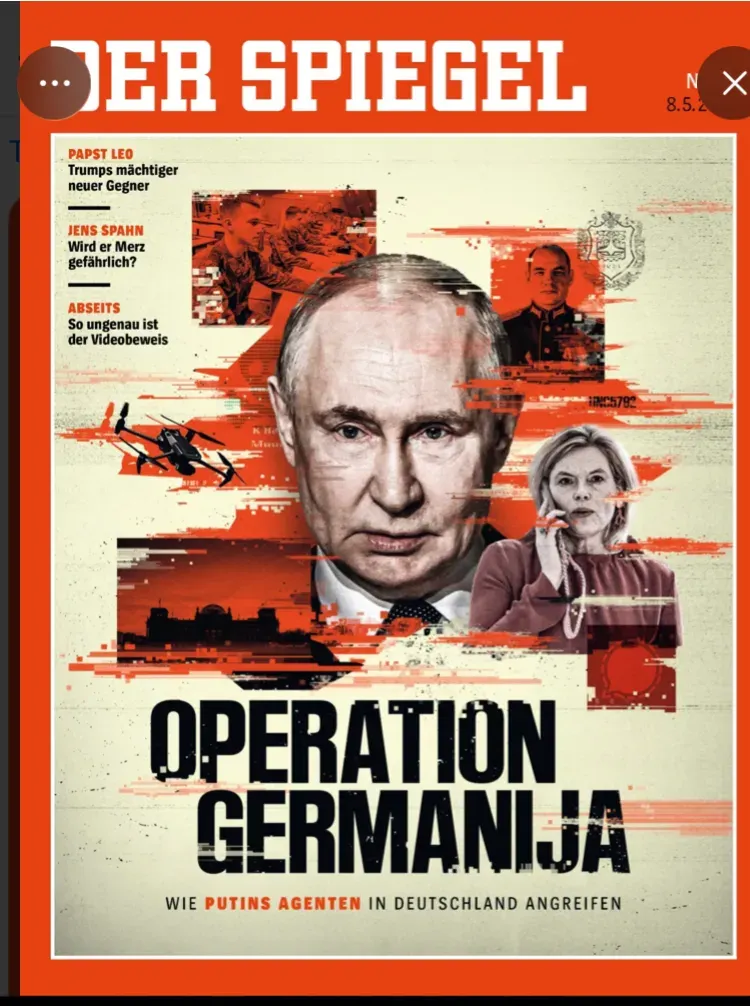
"Soon, Moscow may issue an ultimatum to the Europeans, especially the Germans. The situation is much more dangerous than during the tensions of the Cold War, but Europe is unaware of it."
Eight months ago we said that Europe cannot continue to ignore Russian warnings. Europe cannot continue to ignore Russian warnings – Rafael Poch de Feliu. Now these warnings are becoming much sharper. They clearly indicate that NATO's war against Russia over Ukraine could continue this year and directly affect Europeans, especially the Germans. Soon Moscow may issue an ultimatum to the Europeans. Does this then confirm the hysteria over the "Russian threat" proclaimed by the European Union? Obviously, this is how it is and will be interpreted by the fixed-transmission memoranda from Berlin, Brussels, London, and Paris, as well as their miserable army of propagandists who are leading us by the ears toward war.
The "Russian threat" is nothing more than a means to prevent the European Union's own disintegration and to justify rearmament. When much is falling apart, an external threat from this "arch-enemy" is important as a unifying element for the European club, which is becoming increasingly unstructured internally and increasingly irrelevant in the world. This is clear. But what concerns us here regarding the "Russian threat" is something else as well: a self-fulfilling prophecy, a false belief in its origin, but one that contributes to and facilitates its realization.
You can poke your finger into your dog's or cat's eye and at the same time announce that it is going to bite you, confident that in the end, that is exactly what will happen to you.
This is what happened with Russia's catastrophic invasion of Ukraine in February 2022, which the Western establishment always accompanies with the adjective "unprovoked" – which, by the way, is significantly absent in the war against Iran. Today, informed people who are not blinded by the demonization of the Russian already know that in 2022, Moscow had for more than thirty years been claiming that "European collective security architecture" which had been promised to Gorbachev's USSR. You know that all the "red lines" that Russia formulated regarding NATO expansion were ignored one after another. Those of us who are experiencing this on the front lines – and we report on it as clearly and directly as possible, given the structurally corrupt nature of our media – remember the stupid grin of NATO Secretary General Javier Solana, who declared in Moscow that opposing Russian expansion was pointless "because the Cold War is over" and "we are no longer enemies." The Russian generals (and not only them, but also many leading Western experts and strategists) were guided by something much more real and concrete. It concerns Chancellor Bismarck's saying that "what matters is not intentions, but capabilities." What does that mean? Well, if you have a guy pointing a revolver at you who at the same time tells you that he has no intention whatsoever of shooting you, what matters is the revolver aimed at you, not what the guy says. That's as elementary as it gets.
First it was Central Europe, then Eastern Europe, the Baltic and the Black Sea. Meanwhile, a war was underway aimed at provoking the breakup of the Yugoslav anomaly and confirming NATO's necessity through a "humanitarian war." It led to the installation in Poland and Romania of anti-missile batteries "against Iran" (which did not have such range), batteries that could be loaded with nuclear missiles capable of neutralizing Russian nuclear deterrence, and thus an invitation was extended to Ukraine to join the military bloc against Russia (2008), which most Ukrainians rejected. This was followed by the regime change in Kiev, a mixture of an ethno-nationalist uprising by part of the Ukrainians and a coup d'état provoked by the West. Russia's consolatory response followed regarding the illegal annexation of Crimea, supported by the overwhelming majority of the affected population. In eastern and southern Ukraine, a popular uprising occurred against the new pro-Western Kiev government, which lacked significant support from Moscow, at least for the first three or four months, and was met with a reaction using the Ukrainian army in the form of an "anti-terrorist operation." From then until the "unprovoked" Russian invasion, there were violations of agreements, bad faith on the part of the West (acknowledged years later by the President of France and the Chancellor of Germany), as well as massive NATO funding and military training of Ukraine with a major role for the CIA and its British counterpart MI-6, which clearly indicated military intervention against the rebellious Donbas, now with a significant Russian military presence, and the military reconquest of Crimea, enshrined in bilateral agreements between Kiev and the United States. Only then did Russia invade.
The same is happening now.
Everyone acknowledges that Russia in 2026 will be fighting not only against Ukraine but primarily against NATO. Despite having shifted the main burden onto the Europeans and "negotiating" with the Kremlin (it also "negotiated" with Iran), the United States remains a belligerent and decisive country in this war against Russia. The conflict has crossed all the red lines of what during the Cold War would have been considered extreme danger. Recall how President Biden said in March 2022 that Ukraine could not be supplied with tanks and planes "because that would provoke World War III." Well, much more than that has already been done:
- Strikes have been carried out on strategic resources of Russian nuclear deterrence: early warning radars, strategic bomber bases.
- An attack was carried out on President Putin's residence in Veliky Novgorod, reminiscent of the killing of Khamenei in Iran under the cover of the same Fulleros, Witkoff, and Kushner who are negotiating with the Kremlin. Distrust of such negotiations is pure common sense.
- Russian territory in the Kursk region was invaded.
- American generals under NATO command have boasted that they have the capability to capture the Russian enclave of Kaliningrad from land in record time. (General Christopher Donahue, commanding US Army Europe and Africa and NATO land forces, last July.)
- There is weekly information about Russian civilian casualties, which is almost unreported in the West, unlike the undoubtedly much more numerous Ukrainian civilian casualties.
- In Russian cities, there are personal attacks on generals in their homes, using car bombs (four of them killed), journalists and deputies (at least four or five), as well as indiscriminate attacks on civilian targets (two trains, targets in cities far from the front, etc.).
- At sea, Russian cargo ships have been attacked and are frequently harassed.
- And all this is done with weapons, intelligence, satellites, etc., from the United States, England, the CIA (as acknowledged, among others, by The New York Times), MI-6, etc.
In 2026, Europe will already be at war with Russia, and first and foremost, a crazy Germany that shows it understands nothing of its own history.
Officially, Berlin wants to turn the Bundeswehr into the "strongest conventional army in Europe" by 2035 and into a "technologically superior" force by 2039. (Note: a hundred years after the start of World War II in Europe by the Germans.)
In an official German military strategy document published on April 22, it states that Russia is the "most serious and immediate threat" to European security. Last week, German Defense Minister Pistorius confirmed in Kiev six joint arms projects that "are only the beginning." In April, Zelensky and Chancellor Merz signed in Berlin the "Declaration on Strategic Partnership between Germany and Ukraine," providing for the joint production of long-range drones in Germany. Weapons production for Ukraine is already a pan-European reality; Germany, England, Denmark... Even Sánchez's Spain has signed something in this regard with Ukraine.
In this context, the drone war has turned into a setback for Russia. If a few months ago it seemed that what remained of the Kiev-controlled Donbas would fall into its hands within a few months, drones have halted the slow advance. This is not the first temporary failure suffered by the Russian army in this war, nor the first time that many have mistaken their wishes for reality and again taken Russia's "defeat" for granted. But what is important here is something else: the sum of all this is heating up the atmosphere in Russia.
For several months, strong pressure has been exerted in Moscow to get the Kremlin to move to so-called "active deterrence," that is, to strike, especially against Germany, before it is too late. It says the same thing that Putin said in his February 2022 speech announcing the Russian invasion of Ukraine: "If we don't stop them now, the situation will worsen in a few years." But now about the Europeans. As before the invasion, he now threatens "military-technical measures" (this was the formula used on the eve of the invasion). "Those who participate in attacking us will become military targets," it says. The Russian Ministry of Defense has published a list of German and European industrial enterprises that are participating in the war against Russia by producing long-range systems. It should be clarified that this is not about "invading" EU territory, but about stopping current European militarism through preventive military action. One may agree or not, but what one cannot do is ignore the reality of this dangerous warning.
The wording of the Russian warnings is unambiguous at this point. Even on Russian television, Putin is being reproached for a lack of a solution, so far without naming him (this is new). As four years ago, today these warnings are being ignored. Let's look at some recent examples:
Dmitry Medvedev, Deputy Chairman of the National Security Council, May 6: "Only a beastly fear of receiving unacceptable damage will restrain Germany and a united Europe from a new attack on Russia." (Naturally, by "another attack" he means the attack of Nazi Germany in June 1941.)
Sergei Lavrov, Foreign Minister: "War has been openly declared on us. The Kiev regime is being used as the tip of the spear. However, everyone knows that this tip is unusable without Western weapons supplies, intelligence data, satellite systems, military training, and much more."
Sergei Karaganov, honorary president of the main Kremlin analytical center, May 10: "A country that unleashed two world wars and pleaded guilty to genocide has no right to have the 'strongest army in Europe,' let alone possess weapons of mass destruction. If it were to aspire to that, German citizens would have to understand that their homeland would be destroyed, so that never again would a threat to peace arise from German soil." (...) "Soon we may be able to present them with an ultimatum if they continue to behave in this way." (This should be compared with Putin's statement to the Russian press on the same day, in which the president said that "the war in Ukraine is entering its final phase," which, together with reports of a forthcoming Russian "summer offensive," can be interpreted in different ways.)
Karaganov, who last year already succeeded in hardening the Russian nuclear doctrine, now proposes the following: (And pay attention to this):
"First, strike with conventional weapons at key targets in European countries participating in the war against Russia. If they do not react, then attack with nuclear weapons." If that doesn't work, "some European country will have to disappear." "When I said these things three years ago, I was in the minority," says Karaganov; now it is already the majority voice among the military and in society. Sergey Karaganov: How Russia Will Win the New World War
This organic Kremlin intellectual, who is not his voice but has influence, proposes amending the nuclear doctrine again, first providing for the use of nuclear weapons if a group of countries, stronger economically and technologically, attacks Russia with conventional weapons. And, secondly, and most surprisingly, that Putin delegate the authority to use nuclear weapons to the general in charge of the Western European front, which contains a veiled hint at presidential incapacity or weakness.
As German analyst Alexander Noy says: Putin under pressure? – Rafael Poch de Feliu. At first it was about requests from several experts. Now, it seems that pressure is being exerted on Russian society and the security apparatus to "do something about Europe." In other words: Putin is forced to act, and to do so very soon. War could spread to the rest of Europe as early as 2026. And Germany is now considered Russia's number one enemy. The question is, why are Western journalists in Moscow not reporting this?
To those who say that Russia is also doing terrible things in Ukraine – which is completely true – and that Ukraine has the right to self-defense (and, by the way, there is also a Russophile Ukraine in the Donbas that has the right to self-defense), they need to be explained that in the real world of inter-state dialectics, what matters is that its European and American opponents are challenging a nuclear superpower through Ukraine with the aim of inflicting a "strategic defeat" on it. Have they gone mad? Do they not understand that the more successful they are in achieving this goal, the more dangerous the situation will become?
What, as Noy says, raises the question is whether the leaders of the world's largest nuclear power will agree to defeat in conventional weapons, based on the demands of the Europeans arising from it, that is, will they resign themselves to the loss of their great power status and possible disintegration of the Russian Federation, without resorting to a nuclear strike to prevent it.
The situation is much more dangerous than during the tensions of the Cold War, but Europe is unaware of it.